This post was originally published by ITSTIME.
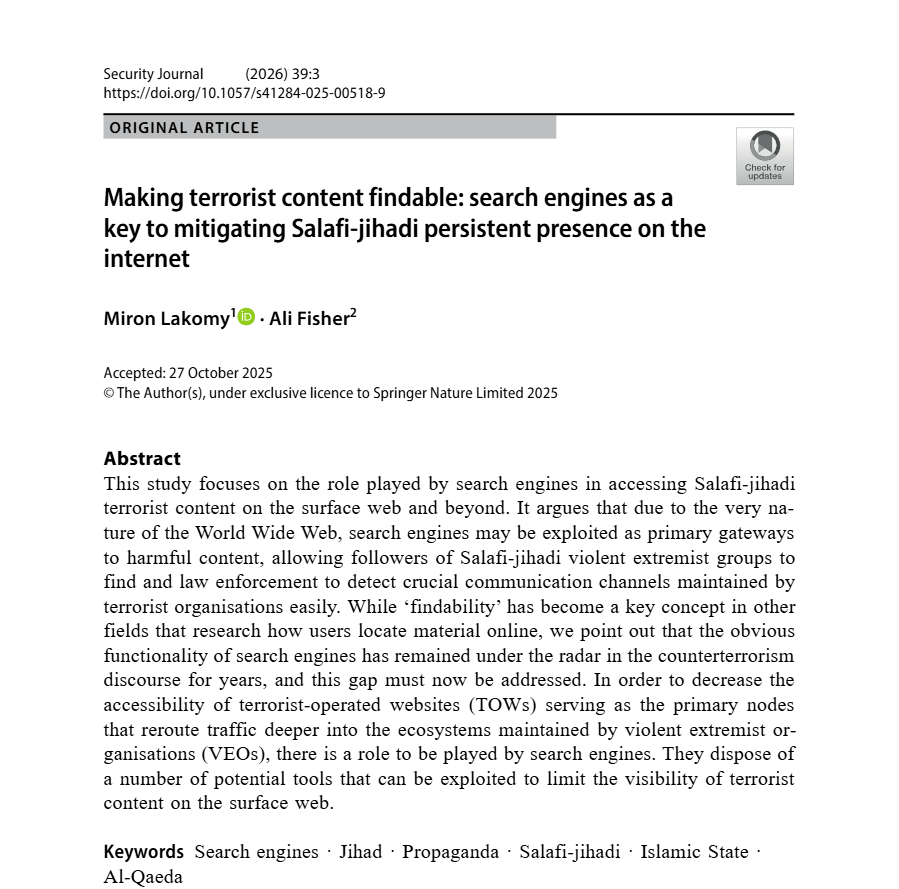
Written with Miron Lakomy, the study, published in Security Journal, focuses on the role played by search engines in accessing Salafi-jihadi terrorist content on the surface web and beyond. It argues that due to the very nature of the World Wide Web, search engines may be exploited as primary gateways to harmful content, allowing followers of Salafi-jihadi violent extremist groups to find and law enforcement to detect crucial communication channels maintained by terrorist organisations easily.
While ‘findability’ has become a key concept in other fields that research how users locate material online, we point out that the obvious functionality of search engines has remained under the radar in the counterterrorism discourse for years, and this gap must now be addressed. In order to decrease the accessibility of terrorist-operated websites (TOWs) serving as the primary nodes that reroute traffic deeper into the ecosystems maintained by violent extremist organisations (VEOs), there is a role to be played by search engines. They dispose of a number of potential tools that can be exploited to limit the visibility of terrorist content on the surface web.
Content is findable.
This study draws from the concept of findability, which is rarely referred to in the conceptual models and actions of counterterrorism actors. In this context, it must be stressed that the fundamental requirement for persistent da’wa is for people to hear it, and for that to occur, it has to be findable. The ability to find information influences what is known as the “information horizon” of an individual. Diane H. Sonnenwald introduced the concept of the information horizon. She argued that “Within any context and situation is an ‘information horizon’ in which individuals can act. Information horizons, which may consist of a variety of information resources, are determined socially and individually, and may be conceptualized as densely populated solution spaces”. The importance of the information horizon in relation to the visibility of terrorist content, is that “in a densely populated solution space, many solutions are assumed, and the information retrieval problem expands from determining the most efficient path to the best solution, to determining how to make possible solutions visible—to an individual(s) and to other information resources”. In a modern environment where search engines are an important part of making ‘possible solutions’ visible, the findability of information is a key concern. If an individual is not aware of information, it cannot be part of their information horizon.
Conclusions
Despite the decade-long struggle to remove content, the working groups, the conferences, the policy discussions and the introduction of new laws, there is little evidence that the ‘findability’ of Salafi-jihadi content has declined significantly. Salafi-Jihadi groups are aware of the opportunity created by search engines. Furthermore, search engines currently constitute one of the primary gateways allowing at least some terrorist supporters to access the terrorist information ecosystem by finding hotspots of communication, including repositories of propaganda, message boards, and social media profiles.
As demonstrated in the article, finding most of the surface web domains containing Salafi-jihadi propaganda does not require any advanced skills and is part of the classic modus operandi employed by the followers of various violent extremist organisations. This constitutes a significant gap that decreases the overall efficiency of terrorist content removal policies employed globally in reaction to AQ and the Islamic State group’s online campaigns. While social media have been pressured to introduce content moderation standards that facilitate identifying and removing harmful, violent extremist materials, this was largely not the case with search engines.
We argue in the article, that the introduction of new measures allowing the delisting of terrorist communication channels from search results is a sine qua non requirement for addressing the problem of digital jihad more efficiently. With the controversial, at best, results of the current content takedown policies, search engines have a certain role to play in mitigating traffic in terrorist information ecosystems. It is doubtful that such solutions would “defeat” the terrorist strategic communication on the surface web, given the results of the content moderation policies introduced by some social media companies. However, it will still be a step in the right direction, which should reduce access to content, especially from the less tech-enabled individuals seeking content that can trigger radicalisation or mobilisation processes.
The full article:
Miron Lakomy and Ali Fisher, “Making terrorist content findable: search engines as a key to mitigating Salafi-jihadi persistent presence on the internet”, Security Journal, 39:3 (2026)
can be accessed here: https://rdcu.be/eP3Vg